Blog
DevOps
Product
2
minutes

Complete Guide: GitOps with Qovery

I am super excited to announce the release of our complete guide on how to run GitOps with Qovery! GitOps revolutionizes infrastructure management by using Git repositories as the source of truth, offering a more streamlined, reliable, and automated workflow.

Romaric Philogène
CEO & Co-founder
Summary
Twitter icon
linkedin icon

Guide: GitOps with Qovery

Our complete guide is available here: Complete Guide on How To Run GitOps with Qovery

Watch this if you are curious to see an example of GitOps with Qovery:

What's GitOps?

GitOps is a methodology that uses Git repositories as the single source of truth for infrastructure and application code. Changes to the infrastructure are made through Git commits, which triggers automated processes to update the infrastructure accordingly.

Benefits of GitOps

  • Streamlined Workflows: Manage infrastructure and application code in a single place.
  • Consistency and Reliability: Every change is versioned and auditable, reducing configuration drift.
  • Enhanced Collaboration: Teams can collaborate better using familiar Git workflows.
  • Automated Deployments: Reduces manual intervention and human error, speeding up deployments.

If you are unfamiliar with the GitOps concept, I recommend this introduction from GitLab.
Why Manage Qovery in a GitOps Way?

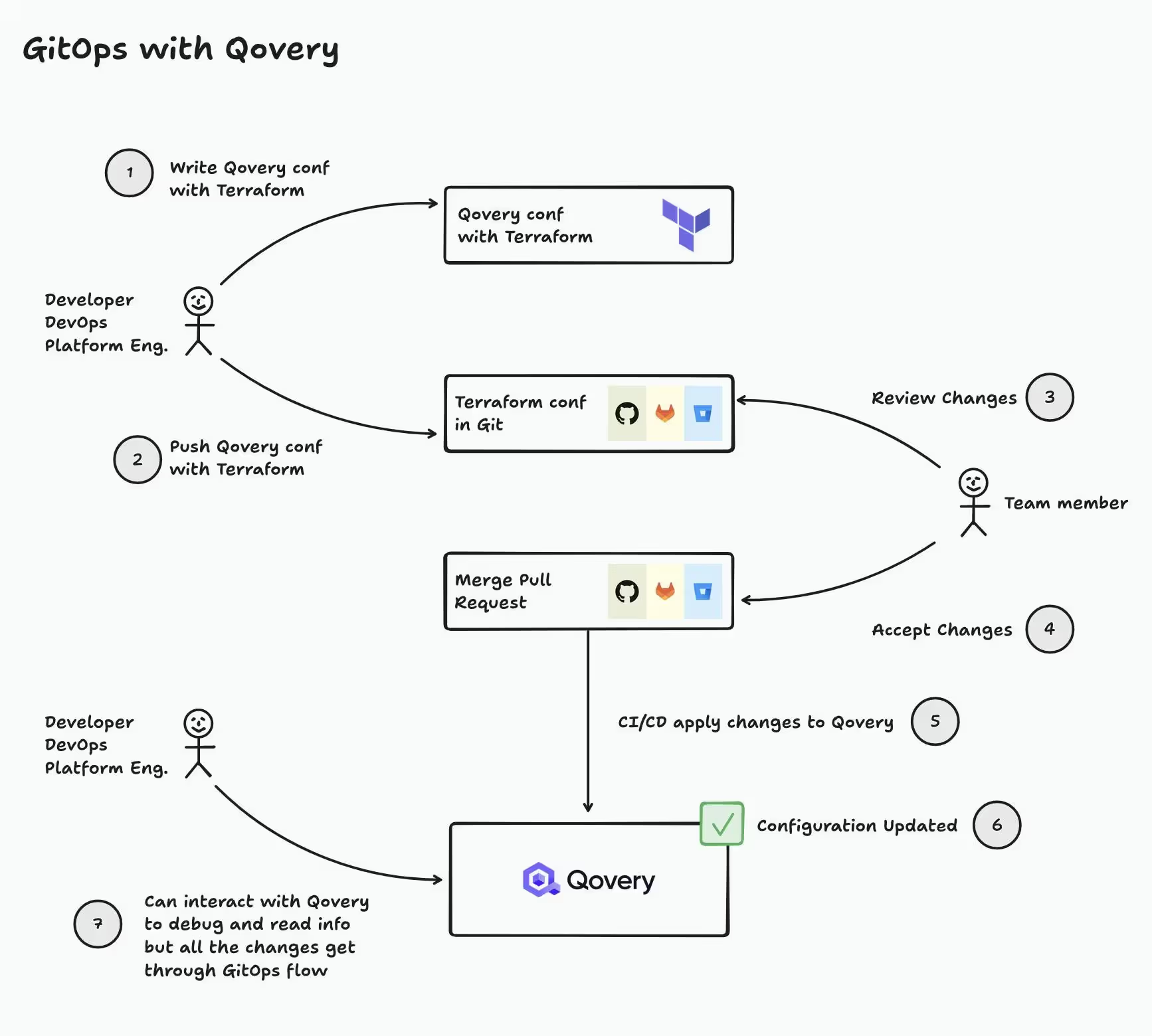
GitOps flow with Qovery

Managing Qovery through GitOps combines the power of Git with Qovery’s robust platform:

  • Unified Management: Manage all Qovery configurations from one repository.
  • Improved Efficiency: Automated processes handle deployments, reducing the need for manual work.
  • Enhanced Control: Git workflows ensure that all changes are tracked and reviewed.

Limitations of GitOps with Qovery

Once you start managing Qovery with GitOps, it's recommended to only make changes through GitOps to avoid resource drift. Drift occurs when the actual state of your infrastructure differs from the state defined in Git, leading to inconsistencies and potential issues. The Qovery web console remains useful for reading information and quickly testing and validating changes but should be used cautiously to prevent drift.

--

Check out our complete guide on GitOps with Qovery for detailed, step-by-step instructions.

Share on :
Twitter icon
linkedin icon
Tired of fighting your Kubernetes platform?
Qovery provides a unified Kubernetes control plane for cluster provisioning, security, and deployments - giving you an enterprise-grade platform without the DIY overhead.
See it in action

Suggested articles

Kubernetes
 minutes
Kubernetes management: Best practices for enterprise ccaling and cost optimization

Master enterprise Kubernetes management in 2026. Learn best practices for security, FinOps, and reliability, and see how AI-agentic platforms simplify operations.

Mélanie Dallé
Senior Marketing Manager
Kubernetes
Platform Engineering
Infrastructure Management
 minutes
The top 3 OpenShift pains in 2026 (and how platform teams respond)

Is OpenShift becoming too expensive or complex for your team? Discover the top 3 OpenShift pain points; from the "pricing inversion" to vendor lock-in and see why agile platform teams are migrating to modular, developer-first alternatives like Qovery.

Mélanie Dallé
Senior Marketing Manager
AI
Qovery
3
 minutes
How Qovery uses Qovery to speed up its AI project

Discover how Qovery leverages its own platform to accelerate AI development. Learn how an AI specialist deployed a complex stack; including LLMs, QDrant, and KEDA - in just one day without needing deep DevOps or Kubernetes expertise. See how the "dogfooding" approach fuels innovation for our DevOps Copilot.

Romain Gérard
Staff Software Engineer
Product
4
 minutes
Scale What Matters, Not Just CPU - Welcome Keda autoscaling

Not every workload should scale on CPU. Qovery brings event-driven autoscaling into the application lifecycle, letting applications scale on real signals like queue depth or request latency.

Alessandro Carrano
Head of Product
DevOps
Kubernetes
Platform Engineering
15
 minutes
10 Red-Hat OpenShift Alternatives to Reduce Cost and Complexity in 2026

Fed up with OpenShift? Compare the top 10 enterprise alternatives. Discover how modern Kubernetes management platforms like Qovery reduce TCO, simplify Day 2 Ops, and scale AI workloads.

Morgan Perry
Co-founder
Kubernetes
DevOps
9
 minutes
Top 10 Rancher alternatives in 2026: Beyond cluster management

Looking for Rancher alternatives? Compare the top 10 Kubernetes Management Platforms for 2026. From Qovery to OpenShift, find the best tool to scale multi-cluster operations and reduce TCO.

Morgan Perry
Co-founder
Internal Developer Platform
DevOps
 minutes
PaaS vs. DIY IDP: The Fastest Path to a Self-Service Cloud

Building an Internal Developer Platform (IDP) from scratch seems cheaper, but the maintenance costs add up. Discover why a modern PaaS on your own infrastructure is the faster, smarter path to a self-service cloud.

Mélanie Dallé
Senior Marketing Manager
Heroku
15
 minutes
Top 10 Heroku Alternatives in 2026: When Simplicity Hits the Scaling Wall

Escape rising Heroku costs & outages. Compare top alternatives that deliver PaaS simplicity on your own cloud and scale without limits.

Mélanie Dallé
Senior Marketing Manager

It’s time to change
the way you manage K8s

Turn Kubernetes into your strategic advantage with Qovery, automating the heavy lifting while you stay in control.