


Platform Engineering: Explained, Benefits, and How to Get Started?



So let’s start with what platform engineering is.
What is Platform Engineering?
Platform Engineering is the process of enabling software engineering teams so they can autonomously perform end-to-end operations of the application life cycle in a cloud environment. Platform Engineers develop an integrated product that provides self-service capabilities to developers. Whether it is infrastructure provisioning, code pipelines, monitoring, or container management, the self-service platform hides all these complexities and provides developers with all the necessities of the entire life cycle of the application. Platform Engineering is not just necessary tooling but a combination of tools, workflows, and processes.
Platform Engineering Key Characteristics
What does a Platform Engineering team do?
The Platform Engineering team provides you with an integrated product having self-service capabilities. This product is built upon many core principles of DevOps. While focusing on automation, efficiency, and tooling, developers can be self-sufficient and productive instead of waiting for the operations team to perform the required tasks. It is a layer on the organization’s existing tools, aiming to automate the deployments and resource allocation. Following are some of the responsibilities of the platform engineering team:
- They create and maintain tools and workflows through which developers can ship their code to production quickly and efficiently.
- They act as a layer between developers and infrastructure so that developers can focus on product development instead of worrying about infrastructure issues.
- They use APIs and web portals to automate workflows, deployments, disaster recovery, etc.
Platform Engineer vs DevOps vs SRE
If you look at the job roles of DevOps, SRE, and Platform Engineers, you will see many things common among them. However, all three are not the same thing. Here is how they are different from each other:
- Goal: SRE’s primary goal is the maximum reliability of the application. Platform Engineers’ main goal is to optimize the speed and efficiency of software delivery operations. DevOps's primary goal is to optimize the development pipeline.
- Scope: The scope of Platform Engineering is software delivery operations. SRE’s scope ensures the application’s reliability, incident response, and infrastructure management. DevOps's scope is to reduce the time between the releases and improve the quality of the release.
- Tools: SRE uses chaos engineering, SLO management, automated incident response, etc. Platform Engineers use tools like source code managers and CI/CD servers to automate software delivery. DevOps use tools for building, monitoring, automated testing, and application containerization.
Main Benefits of Platform Engineering
Platform Engineering provides loads of benefits to businesses operating in a cloud-native environment. The primary aim of Platform Engineering is to empower the developers to consume the services through self-service, delivering a better developer experience. An integrated product developed by the Platform Engineering team fulfills the pure DevOps promise that “you build it, you run it.” Let’s go through some of the benefits of platform engineering to organizations:
Speed up the development cycle
In the absence of Platform Engineering, the processes are not automated. Whether it is manual creation and configuration of your repository, management of your cloud infrastructure, or creating CI/CD pipelines, the manual processes take time and are error-prone. Platform Engineering focuses heavily on automating your processes. As a result, developers can ship their code quicker with the help of automation platforms. Now that developers can spin up an environment and ship their software releases through self-service, the development cycles will speed up tremendously. A fully automated code pipeline integrated with automated test cases will deliver business value to your customers without compromising quality or speed. As a result, the time to market your product will be reduced.
Remove the operational complexity
The self-service deployments for infrastructure and applications remove the complexity of the processes. Platform Engineering automates the entire DevOps cycle, which results in increased productivity and takes much burden away from developers. In the traditional approach, developers depend on DevOps teams to create and maintain the software deployments. In the modern approach of self-service portals, developers are autonomous and use the self-service portals to deliver rapid releases. This reduces the overall bottlenecks in the organizational processes.
Take your product development to the next level
Consider a scenario where a developer has to ship a slight change in a microservices-based application, first in staging and then to the production environment. It is a multi-cluster Kubernetes environment. Only a developer who has mastered the skills of Kubernetes, helm charts, and Terraform modules can do it himself. Smaller organizations cannot have the luxury of employing such superstar developers. Still, with the help of platform engineers, developers do not need to offload the work to the Ops team. A developer can ship the code to any environment with a few clicks without mastering the underlying complexities. This improves the feedback iterations among the different team members resulting in a much-refined product with immense business value to the customers.
Scale your application through environment automation
Most current CI/CD setups mainly focus on updating the container images. The CI servers build them and update the image path in the configuration. However, it gets complex when you need to do things like:
- Spinning up a new environment
- Removing an environment variable or changing the configuration of an existing environment
- Rolling back a newly provisioned environment
- Adding/removing resources from an environment
Platform Engineers facilitate the development teams with full fledge environment automation as well. Developers can create, replicate, remove, and update deployment environments without knowing the things happening in the background. That means even a junior UX developer can self-service an environment that is fully provisioned with everything you need to deploy and test. The ability to automate the environment allows businesses to scale quickly and efficiently.
The benefits mentioned above of a Platform Engineering team are very alluring, which brings up the question of whether every business should adopt it or not. Let’s discuss some of the essential use cases for platform engineering.
When Does an Organization Need a Platform Engineering Team?
Suppose you have cross-functional teams managing application infrastructure, development, and operations. In that case, you should opt for Platform Engineering because you already do some platform engineering without knowing it. There are many other use cases for adopting platform engineering as below:
You want your core team to focus on product development.
Suppose you want your application teams to focus on product development instead of indulging in activities like infrastructure provisioning, code pipelines, secrets management, etc. In that case, you should go for Platform Engineering. Note that your application developers might not know the required automation tooling for infrastructure and applications. Platform Engineering will allow development teams to self-service and ship their code to production with minimal effort.
You have a growing engineering team
If you have a growing engineering team trying to scale the application but facing challenges, you should opt for platform engineering. Cloud-native applications become complex as they grow. Achieving scalability not only requires strong technical expertise but solid coordination among different teams too. Not all the team members in a development team are technically adept at handling the operational complexities of scaling. Even one weak link in the team reduces the team's velocity and slows down the whole development cycle. Platform Engineers would be ideal in this case. They would facilitate the core development team by developing a product having self-service capabilities. Now that developers are more autonomous and self-sufficient in application life cycle activities, the team will be able to meet the scalability needs efficiently.
You want constant innovation along with application development
Platform Engineering is best for you if you have a permanent team that can keep working on the constant innovation and improvements on how cloud-native applications are deployed. They would aim to facilitate the core development team to gain a competitive advantage by utilizing the self-service portals. The Platform Engineering team, in this case, will be experimenting and learning new practices, tools, and technologies.
How to Get Started with Platform Engineering?
Now that you know all the benefits of Platform Engineering, you must think about how to start and take advantage of all the promises of Platform Engineering. This is where Qovery comes in. Qovery offers everything you need to build your own platform, providing a seamless deployment experience to your developers.
Qovery is equipped with powerful features like Cloning Environments or Preview Environments, which allow developers to quickly provision a working deployment environment based on staging or production environment. You can utilize your existing platform engineering tools and technologies, like Terraform, Kubernetes, Helm, Docker, AWS, etc., with Qovery. Not only that, Qovery has strong integration with the full DevOps toolchain used for CI/CD, monitoring, etc. Qovery makes developers autonomous and efficient with their software release processes making their life easier.
To experience first-hand the power of Qovery's On-demand environments, start a 14-day free trial.
Sign–up here - no credit card required!


.svg)
.svg)
.svg)

Suggested articles


At enterprise scale, managing provider-specific Kubernetes YAML across multiple clouds creates crippling configuration drift and operational toil. By adopting an agentic Kubernetes management platform, infrastructure teams abstract cloud-specific configurations (like ingress controllers and storage classes) into a single, declarative intent that automatically reconciles across 1,000+ clusters.


To stop GPU costs from destroying SaaS margins, teams must transition from static to consumption-based infrastructure by utilizing Karpenter for dynamic provisioning, maximizing hardware density with NVIDIA MIG, and leveraging Qovery to tie scaling directly to business metrics.
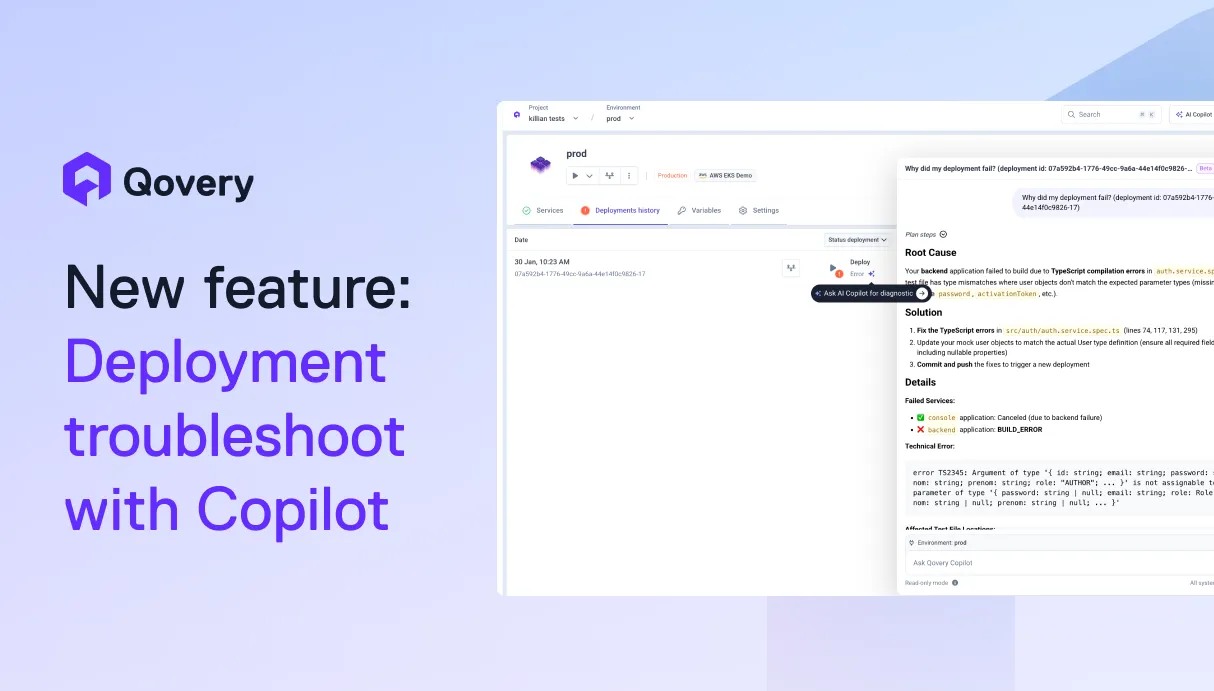
AI is helping developers write more code, faster than ever. But writing code is only half the story. What happens after? Building, deploying, debugging, scaling. That's where teams still lose hours.We're building Qovery for this era. Not just to deploy your code, but to make everything that comes after writing it just as fast.




By adopting GitOps and utilizing management platforms like Qovery, fintech teams can automatically generate DORA-compliant audit trails, transforming regulatory compliance from a manual, time-consuming chore into an automated, native byproduct of their infrastructure.
Kubernetes success is determined by Day 2 execution, not Day 1 deployment. While migration is a bounded project, maintenance is an infinite loop that often consumes 40% of senior engineering capacity. To protect margins and velocity, enterprises must transition from manual toil to agentic automation that handles scaling, security, and cost.

Day-0 is planning, Day-1 is deployment, and Day-2 is the infinite lifecycle of maintenance. While Day-0/1 are foundational, Day-2 is where enterprise operational debt accumulates. At fleet scale (1,000+ clusters), managing these differences manually is impossible, requiring agentic automation to maintain stability and eliminate toil.


.webp)