Blog
Scaleway
Product
1
minutes

Deploy your apps on Scaleway with Qovery! Get early access now

TLDR; Deploy your apps on Scaleway - Qovery supports Scaleway cloud service provider!

September 26, 2025
Romaric Philogène
CEO & Co-founder
Summary
Twitter icon
linkedin icon

When we launched Qovery in January 2020, our product was only supporting app deployment on Amazon Web Services (AWS). 20 months later, 5534 developers from more than 120 countries use Qovery to deploy their apps on AWS and Digital Ocean.

EDIT: You can now deploy your apps on Scaleway with Qovery! Read this guide

Today, more and more European companies would love to benefit from the excellent user experience of Qovery on a European cloud service provider 🇪🇺. This is why we are proud to announce that we are working on a partnership with Scaleway, the leading European cloud provider, to respond to the need of our users.
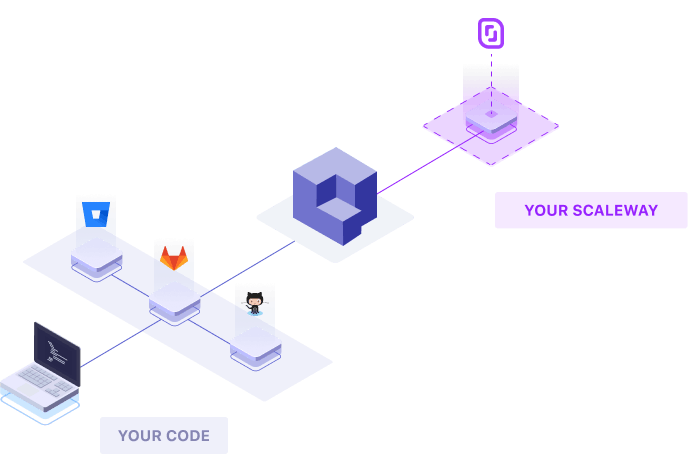
Illustration of Qovery and Scaleway integration
At Qovery, we strive to make the developer experience as simple as possible to deploy their apps in the cloud.

We are proud to announce that the early access registration to deploy your apps on Scaleway with Qovery is open.

Deploy on Scaleway with Qovery

Do you have any questions? Ask here.

--

Curious to know more about how we integrate Scaleway with Qovery? Here is the Pull Request.

Check out our public roadmap.

--

Share on :
Twitter icon
linkedin icon
Tired of fighting your Kubernetes platform?
Qovery provides a unified Kubernetes control plane for cluster provisioning, security, and deployments - giving you an enterprise-grade platform without the DIY overhead.
See it in action

Suggested articles

Kubernetes
 minutes
How to automate environment sleeping and stop paying for idle Kubernetes resources

Scaling your deployments to zero is only half the battle. If your cluster autoscaler does not aggressively bin-pack and terminate the underlying worker nodes, you are still paying for idle metal. True environment sleeping requires tight integration between your ingress layer and your node provisioner to actually realize FinOps savings.

Mélanie Dallé
Senior Marketing Manager
Kubernetes
DevOps
6
 minutes
10 best Kubernetes management tools for enterprise fleets in 2026

The biggest mistake enterprises make when evaluating Kubernetes management platforms is confusing infrastructure provisioning with Day-2 operations. Tools like Terraform or kOps are excellent for spinning up the underlying EC2 instances and networking, but they do absolutely nothing to prevent configuration drift, automate certificate rotation, or right-size your idle workloads once the cluster is actually running.

Mélanie Dallé
Senior Marketing Manager
DevOps
Kubernetes
Platform Engineering
6
 minutes
10 best Red Hat OpenShift alternatives to reduce licensing costs

For years, Red Hat OpenShift has been the safe choice for heavily regulated, on-premise environments. It operates as a secure fortress. But in the public cloud, that fortress acts as an expensive prison. Paying proprietary per-core licensing fees on top of your standard AWS or GCP compute bill is a redundant "middleware tax." Escaping OpenShift requires decoupling your infrastructure from your developer experience by running standard, vanilla Kubernetes paired with an agentic control plane.

Morgan Perry
Co-founder
AI
Product
3
 minutes
Qovery Skill for AI Agents: Deploy Apps in One Prompt

Use Qovery from Claude Code, OpenCode, Codex, and 20+ AI Coding agents

Romaric Philogène
CEO & Co-founder
Kubernetes
 minutes
Stopping Kubernetes cloud waste: agentic automation for enterprise fleets

Agentic Kubernetes resource reclamation is the practice of using an autonomous control plane to continuously identify, suspend, and delete idle infrastructure across a multi-cloud Kubernetes fleet. It replaces manual cleanup and reactive autoscaling with intent-based policies that act on business state, eliminating the configuration drift and cloud waste typical of unmanaged fleets.

Mélanie Dallé
Senior Marketing Manager
Platform Engineering
Kubernetes
DevOps
10
 minutes
What is Kubernetes? The reality of Day-2 enterprise fleet orchestration

Kubernetes focuses on container orchestration, but the reality on the ground is far less forgiving. Provisioning a single cluster is a trivial Day-1 exercise. The true operational nightmare begins on Day 2. Teams that treat multi-cloud fleets like isolated pets inevitably face crushing YAML configuration drift, runaway AWS bills, and severe scaling bottlenecks.

Morgan Perry
Co-founder
Kubernetes
DevOps
5
 minutes
Top 10 Rancher alternatives in 2026: beyond cluster management

Rancher solved the Day-1 problem of launching clusters across disparate bare-metal environments. But in 2026, launching clusters is no longer the bottleneck. The real failure point is Day-2: managing the operational chaos, security patching, and configuration drift on top of them. Rancher is a heavy, ops-focused fleet manager that completely ignores the application developer. If your goal is developer velocity and automated FinOps, you must graduate from basic fleet management to an intent-based Kubernetes Management Platform like Qovery.

Morgan Perry
Co-founder
AI
Compliance
Healthtech
 minutes
Agentic AI infrastructure: moving beyond Copilots to autonomous operations

The shift from AI copilots to autonomous agents is redefining infrastructure requirements. Discover how to build secure, stateful, and compliant Agentic AI systems using Kubernetes, sandboxing, and observability while meeting EU AI Act standards

Mélanie Dallé
Senior Marketing Manager

It’s time to change
the way you manage K8s

Turn Kubernetes into your strategic advantage with Qovery, automating the heavy lifting while you stay in control.