


A month after switching from Slack to Discord in a tech startup


The background
Qovery is a remote-first startup founded at the end of the last year. I was hired as the first full-time employee. We are all distributed and work remotely. All our communication happens online. Meetings, plannings, brainstorming sessions, talks with founders, technical discussions, and all the rest - it all happens online without exception.
Our product is focused on solving the developers' problems. We help them in deploying their applications on the cloud. We work with all types of programmers - passionate hobbyists, innovative startup guys, serious enterprise architects, and programming newbies. This is why we work with many different kinds of applications and need to answer various community questions.
This makes it crucial for us to have a tool that allows communicate flawlessly with our community and internally within our startup, as all our communication happens online.
What made us switch
Slack is not the wrong tool. There's a reason why it's so popular. But, like all tools, it's not perfect.
What we didn't like was primarily the message history limit. On Slack, you have to pay per user. If you want to preserve the chat history for a growing number of community users, this can get pretty expensive quickly. In this regard, it doesn't support our needs. Don't get me wrong - we are willing to pay for the tools we use, but the Slack pricing model is not well suited for a community communication tool.
We talk (voice) a lot. We think it's essential to communicate effectively using our tools, especially when that's the only verbal communication channel. Slack was not doing its job well in this regard. Sound, connection issues, and noticeable sound delay despite decent internet connection made the experience not perfect. It's not only a Slack issue - we tried many other tools, too, and they all often face similar problems.
Solution?
Discord? It's a tool for online gamers. Maybe, but... "On paper" it looked like it could fix all the problems we had with Slack. No history limit; focus on excellent voice communication... We decided to ignore the "it's a tool for gamers only' stereotype and took a bold move to try it in our organization. What's the result?
What was expected to be better is better
In practice, all promises Discord gave us, in real day-to-day usage, turned out to be true:
- Pricing model - we no longer have to pay per user to keep our chat history. You could use it, in fact, for free. We spend less than 80$ per month now for even better audio quality and H.D. video calls. The price won't change with our growing number of community users.
- Voice / Video chats. This is where Discord shines. The audio quality is excellent, screen sharing works flawlessly, the latency between you speaking and your listeners hearing it is much lower than on Slack and other solutions. Also, what I like is you do not have to call somebody directly or prepare a group calls - you can enter a voice channel (Teamspeak and Ventrilo nostalgic memories...).
What was expected to be worse, is in fact, worse.
- Integrations - we were aware that Discord lacks some of the integrations we used on Slack as a mainly gamers' tool. Slack has a huge advantage in this space. However, thanks to webhooks combined with Zapier, we could configure all integrations we had before also Discord.
- Threaded messages - we were aware that it's missing in Discord, and in fact, it's painful. I do miss it. I wish it were there.
What surprised...
positively
What surprised me from the first second I launched the Discord app was the smoothness and responsiveness. It runs genuinely, noticeably, SMOOTHER and FASTER than Slack. Using Slack in comparison to Discord feels like being in a slow mode for me now. I ultimately didn't expect this (I was not aware that Slack was so clunky). It's simply a pleasure to use Discord.
Another thing that surprised me is that Discord seems to grow fast. In just a month of our usage, the added noise suppression eliminates random noises from your background and an option to turn on the webcam during talks on group channels.
negatively
What surprised me was a very inconvenient upload of very long texts (e.g., application logs). If your copy-paste a very long text, it won't be displayed in the chat in any way - it appears as a text file to download instead.
Another thing - file upload size limits are a bit restrictive. There are no limits for the workspace like on Slack, but the limits are pretty harsh for a single file upload (8MB / 50MB/ 100MB depending on your plan). This means you'll have to share your files elsewhere.
My final thoughts after one month of switching to Discord
I'm selfish. I wish Discord would change focus from gamers to professionals. It would then be the perfect tool for any I.T. organization. But for now, these are my dreams - the reality is that Discord is much better for voice conversations. The app works much smoother and feels more responsive & modern. Chat is worse due to the lack of threaded messages.
In my opinion, you should use Discord if:
- you value quality voice conversations
- you communicate a lot with your users/community
- you don't mind using gamers focused tool (the U.I. is less suited for enterprise usage than Slack)
I think Discord may gradually turn into a more business-oriented tool. They add features that are useful for I.T. teams. There's yet a bit to be done, but I hope it will naturally go in this direction. There are a lot of open-source communities using Discord to build their communities at the moment (including Rust, Django, Hasura, Typescript, and many others), and I believe Discord's popularity will grow in our industry.
And, in the end, they use Rust, so no wonder why Discord works so smoothly! :)
P.S. If you want to try Discord or ask our team or me any questions, feel free to join our Discord server.


.svg)
.svg)
.svg)

Suggested articles


To stop GPU costs from destroying SaaS margins, teams must transition from static to consumption-based infrastructure by utilizing Karpenter for dynamic provisioning, maximizing hardware density with NVIDIA MIG, and leveraging Qovery to tie scaling directly to business metrics.

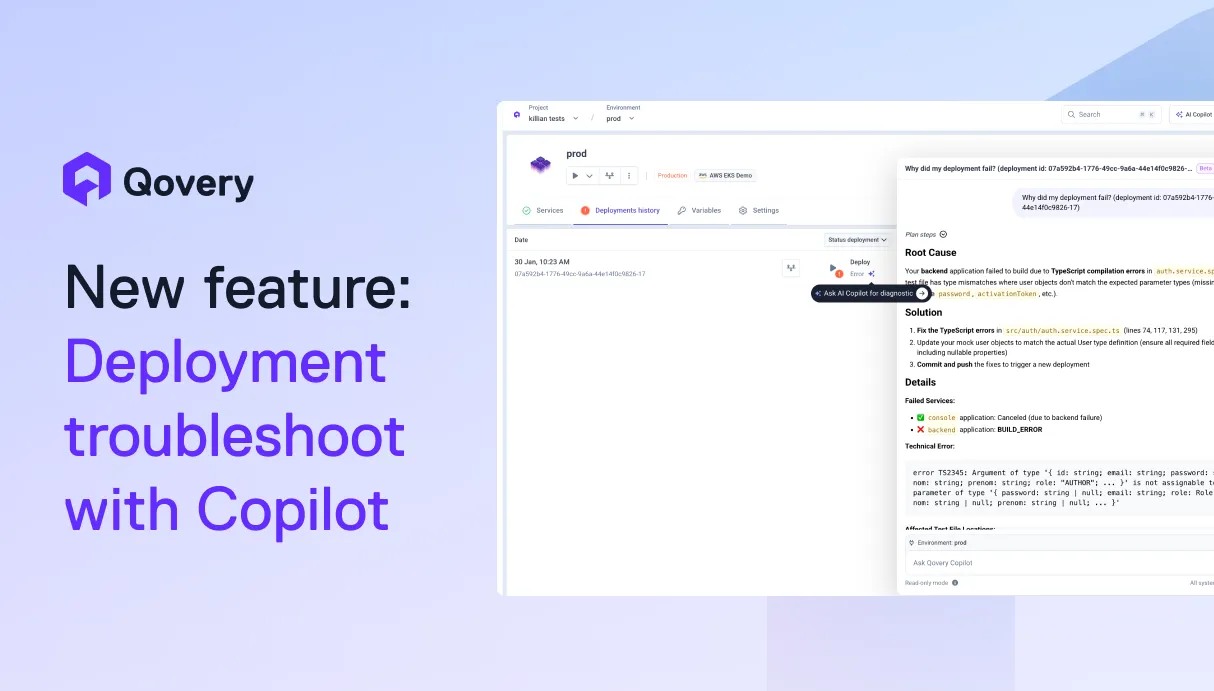
AI is helping developers write more code, faster than ever. But writing code is only half the story. What happens after? Building, deploying, debugging, scaling. That's where teams still lose hours.We're building Qovery for this era. Not just to deploy your code, but to make everything that comes after writing it just as fast.



By adopting GitOps and utilizing management platforms like Qovery, fintech teams can automatically generate DORA-compliant audit trails, transforming regulatory compliance from a manual, time-consuming chore into an automated, native byproduct of their infrastructure.
Kubernetes success is determined by Day 2 execution, not Day 1 deployment. While migration is a bounded project, maintenance is an infinite loop that often consumes 40% of senior engineering capacity. To protect margins and velocity, enterprises must transition from manual toil to agentic automation that handles scaling, security, and cost.
Day-0 is planning, Day-1 is deployment, and Day-2 is the infinite lifecycle of maintenance. While Day-0/1 are foundational, Day-2 is where enterprise operational debt accumulates. At fleet scale (1,000+ clusters), managing these differences manually is impossible, requiring agentic automation to maintain stability and eliminate toil.
A multi-cluster Kubernetes architecture distributes application workloads across geographically separated clusters rather than a single environment. This strategy strictly isolates failure domains, ensures regional data compliance, and guarantees global high availability, but demands centralized Day-2 control to prevent exponential cloud costs and operational sprawl.


.webp)