


Best CI/CD tools for Kubernetes: streamlining the cluster


Key Points:
- Automation Over Manual YAML: Modern Kubernetes CI/CD has shifted from manual manifest management to automated GitOps and "Environment as a Service" (EaaS) models.
- The Rise of Ephemeral Environments: Leading tools now prioritize the ability to spin up temporary, full-stack preview environments for every pull request to ensure faster feedback loops.
- Infrastructure Abstraction: To overcome the "Kubernetes complexity wall," teams are adopting platforms that hide the intricacies of cluster management while maintaining high availability and security.
The Cluster Challenge: Why Standard CI/CD Isn't Enough
Standard CI/CD tools often stop at the "build" stage, leaving a massive gap when it comes to the "deploy" and "operate" stages in Kubernetes. Modern engineering teams face:
- YAML Overload: Developers spend too much time "babysitting" complex Kubernetes manifest files instead of writing code.
- Environment Contention: Fixed staging environments create a queue of developers waiting to test their changes.
- Security Gaps: Traditional tools often require broad, insecure access to clusters, whereas modern platforms use "security by design" with federated identities and real-time audit logs.
Comparison: 10 CI/CD tools for Kubernetes
1. Qovery: The CI/CD & Automation Platform for Kubernetes
Qovery is the premier choice for teams that need a developer-friendly Kubernetes experience without sacrificing enterprise-grade control. It is a complete DevOps automation tool that integrates CI/CD, infrastructure management, and observability into a single platform.
Key Features:
Automated ephemeral environments for pull requests, "Heroku-like" interface on your own cloud (BYOC), and native support for Blue/Green and Canary rollouts.
Best For:
High-growth teams that want to eliminate operational friction and provide a self-service experience on AWS, GCP, or Azure.
Considerations:
Teams requiring extreme, non-standard manual overrides of the Kubernetes control plane may find the "Golden Path" approach too restrictive.

2. Argo CD
The industry standard for Git-driven continuous delivery (CD).
- Strengths: Excellent at ensuring your cluster's actual state matches the desired state defined in Git.
- Weaknesses: It is not a full CI tool. You must pair it with an external system like GitHub Actions for the build stage.
3. GitHub Actions
The best choice for teams already standardized on GitHub.
- Strengths: Native integration removes authentication friction and offers thousands of community-built "actions".
- Weaknesses: Costs can escalate quickly with per-minute pricing, and it lacks built-in environment orchestration.
4. CircleCI
Known for providing the fastest cloud-based builds through intelligent caching.
- Strengths: Exceptional parallelism and a Docker-first approach that makes containerized builds seamless.
- Weaknesses: Limited self-hosted options and complex pricing for high-resource jobs.
5. GitLab CI/CD
A unified platform that handles the entire DevSecOps lifecycle.
- Strengths: Tight integration between the code repository and built-in security scanning.
- Weaknesses: Steeper pricing for advanced features and can feel bloated for teams that only need CI/CD.
6. Jenkins X
A specialized version of Jenkins redesigned specifically for Kubernetes.
- Strengths: Built-in GitOps and preview environment capabilities.
- Weaknesses: Highly complex to set up and maintain; prone to plugin compatibility issues.
7. Codefresh
A CI/CD platform built from the ground up for containers and GitOps.
- Strengths: Unified visibility across build and deployment, powered by Argo.
- Weaknesses: Primarily a commercial product, which may not suit teams strictly seeking open-source.
8. Octopus Deploy
The "best-of-breed" for complex release orchestration in enterprise environments.
- Strengths: Superior multi-tenancy support for deploying to thousands of customers simultaneously.
- Weaknesses: Can be overkill for smaller teams with simpler deployment needs.
9. Harness
An AI-driven CD platform that focuses on "smart automation".
- Strengths: Uses AI to provide deployment verification and automatic rollback recommendations.
- Weaknesses: Enterprise-heavy focus and pricing that reflects it.
10. Northflank
An all-in-one platform for CI/CD and infrastructure management.
- Strengths: Unified pipelines that orchestrate deployments across staging and production on any cloud.
- Weaknesses: Advanced DevOps teams might find its opinionated abstractions restrictive for highly custom setups.
Conclusion: Streamlining Your Cluster
Choosing the right tool depends on your team's specialized needs. If you need a pure GitOps engine and have the headcount to maintain it, Argo CD is the industry standard.
However, for teams looking to eliminate unnecessary operational friction (the time spent managing YAML and infrastructure instead of shipping features) Qovery provides the most direct path to developer self-service on your own infrastructure.


.svg)
.svg)
.svg)

Suggested articles


At enterprise scale, managing provider-specific Kubernetes YAML across multiple clouds creates crippling configuration drift and operational toil. By adopting an agentic Kubernetes management platform, infrastructure teams abstract cloud-specific configurations (like ingress controllers and storage classes) into a single, declarative intent that automatically reconciles across 1,000+ clusters.
To stop GPU costs from destroying SaaS margins, teams must transition from static to consumption-based infrastructure by utilizing Karpenter for dynamic provisioning, maximizing hardware density with NVIDIA MIG, and leveraging Qovery to tie scaling directly to business metrics.
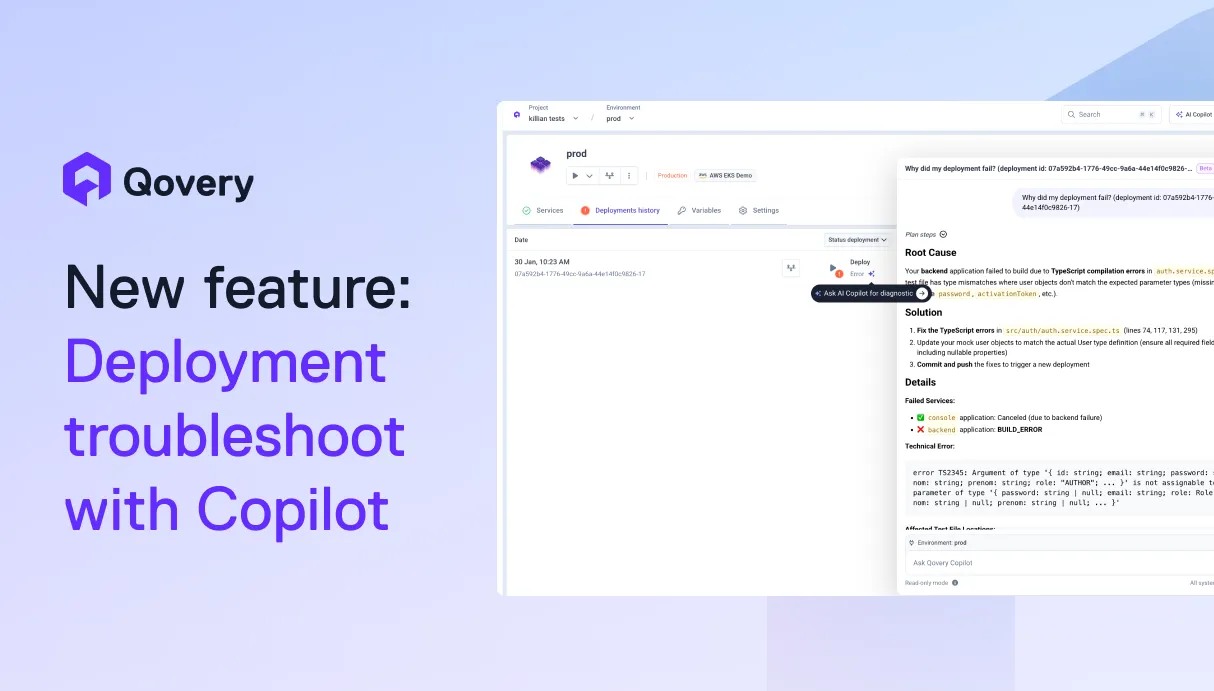
AI is helping developers write more code, faster than ever. But writing code is only half the story. What happens after? Building, deploying, debugging, scaling. That's where teams still lose hours.We're building Qovery for this era. Not just to deploy your code, but to make everything that comes after writing it just as fast.



By adopting GitOps and utilizing management platforms like Qovery, fintech teams can automatically generate DORA-compliant audit trails, transforming regulatory compliance from a manual, time-consuming chore into an automated, native byproduct of their infrastructure.
Kubernetes success is determined by Day 2 execution, not Day 1 deployment. While migration is a bounded project, maintenance is an infinite loop that often consumes 40% of senior engineering capacity. To protect margins and velocity, enterprises must transition from manual toil to agentic automation that handles scaling, security, and cost.
Day-0 is planning, Day-1 is deployment, and Day-2 is the infinite lifecycle of maintenance. While Day-0/1 are foundational, Day-2 is where enterprise operational debt accumulates. At fleet scale (1,000+ clusters), managing these differences manually is impossible, requiring agentic automation to maintain stability and eliminate toil.



.webp)