


Top 10 Heroku Postgres competitors for production databases


Key Points:
- Move Beyond the Shared Cloud: As Heroku Postgres pricing scales aggressively, teams are seeking alternatives that offer better cost-to-performance ratios and multi-cloud flexibility.
- Production-Grade Reliability: While Heroku remains simple, modern competitors provide more robust high-availability (HA), automated failover, and point-in-time recovery (PITR) at a lower entry price.
- The Power of Ownership: Platforms like Qovery allow you to keep your data in your own AWS, GCP, or Azure account, providing the compliance and security that Heroku’s managed layer often restricts.
Why Teams are Leaving Heroku Postgres
For over a decade, Heroku Postgres was the default choice for developers. However, the landscape has shifted. Engineering teams are increasingly frustrated by high costs at scale, regional limitations, and a lack of granular infrastructure control.
Before evaluating the alternatives, it is helpful to clarify the technology: Heroku is a Platform-as-a-Service (PaaS) used to host and run your application code. PostgreSQL is the open-source database software used to store your data. Most teams searching for "competitors" are specifically looking to replace Heroku Postgres - the managed database product provided by Heroku.
Pro-Tip: If you are looking to replace the platform where your code lives (not just the database), check out our guide: Top 10 Heroku Alternatives: When Simplicity Hits the Scaling Wall.
Top 10 Heroku Postgres Competitors for Production Databases
We evaluated these alternatives based on their ability to handle production-grade workloads, their developer experience, and their pricing transparency.
1. Qovery: The #1 Heroku Postgres Alternative
Qovery is the premier choice for teams that want the Heroku experience but on their own cloud. Instead of hosting your data on a third-party account, Qovery automates the deployment of production-grade PostgreSQL directly into your AWS, GCP, Azure, or Scaleway accounts.
Key Features:
- Bring Your Own Cloud (BYOC): Maintain 100% data ownership and security compliance.
- Managed High Availability: Automated failover and backup management without Kubernetes complexity.
- Environment Cloning: Spin up ephemeral database copies for pull requests or staging in seconds.
- Cost Transparency: Pay for the raw cloud resources at cost, avoiding Heroku's massive markups.
- How it differs from Heroku: Qovery doesn't just manage the database; it manages the infrastructure under the database in your own cloud. This eliminates vendor lock-in while maintaining the "git push" simplicity developers love.
- Pricing: Free tier available for small projects; Professional plans start at $29/month.
- Best for: Startups and mid-market companies that need production reliability and data sovereignty without hiring a dedicated DevOps team.

2. Neon
Neon is a serverless PostgreSQL alternative that separates storage from compute.
- Strengths: It features database branching, allowing developers to branch their data just like they branch code. Its serverless nature means it can scale to zero when not in use, saving money on development environments.
- Weaknesses: Cold start times, while fast, can still impact latency-sensitive production applications compared to always-on instances.
3. Amazon RDS (PostgreSQL)
The industry standard for AWS-native teams.
- Strengths: Offers massive extension support (over 90+ extensions) and deep integration with the AWS ecosystem (IAM, CloudWatch).
- Weaknesses: The management console is notoriously complex for non-DevOps users, and it lacks the seamless "developer-first" experience of a PaaS.
4. Supabase
An open-source Firebase alternative built entirely on PostgreSQL.
- Strengths: It provides more than just a database, including built-in Auth, Edge Functions, and real-time listeners.
- Weaknesses: If you only need a database, the additional "backend-as-a-service" features might add unnecessary complexity and potential vendor lock-in.
5. Northflank
A modern developer platform offering multi-cloud PostgreSQL.
- Strengths: Excellent UI and support for multiple cloud providers (AWS, GCP, Azure). It offers a smooth migration path for teams coming from Heroku.
- Weaknesses: Pricing can become complex as you add read replicas and high-availability nodes across different regions.
6. DigitalOcean Managed Databases
The go-to for predictable, affordable hosting.
- Strengths: Very transparent pricing and an incredibly simple setup. It’s ideal for teams that have outgrown Heroku’s Essential tier but aren't ready for full AWS RDS complexity.
- Weaknesses: Limited advanced tuning options and fewer global regions compared to the "Big Three" cloud providers.
7. Google Cloud SQL
Fully managed Postgres on GCP.
- Strengths: Exceptional performance for teams already using Google’s data tools (BigQuery, Looker).
- Weaknesses: Like AWS RDS, it requires significant cloud knowledge to configure securely for production.
8. Aiven
A specialized multi-cloud data platform.
- Strengths: Aiven excels at managing databases across multiple clouds simultaneously, offering high uptime guarantees and excellent support.
- Weaknesses: Targeted heavily toward larger enterprises, with a price point that may be too high for smaller startups.
9. Railway
A developer-focused PaaS known for speed.
- Strengths: You can deploy a Postgres instance in literally two clicks. Its usage-based pricing is very friendly for early-stage prototypes.
- Weaknesses: Currently lacks the deep "Bring Your Own Cloud" infrastructure control that larger production teams require for compliance.
10. Fly.io
A platform that runs your apps (and your data) close to your users.
- Strengths: Allows you to run Postgres "at the edge," significantly reducing latency for global users.
- Weaknesses: Managing high availability and backups on Fly.io requires more manual oversight compared to fully managed "set and forget" services.
Conclusion: Choosing the Right Successor
Transitioning away from Heroku Postgres is no longer just about saving money; it’s about unleashing your infrastructure. If you need a serverless approach for dev environments, Neon is excellent.
If you are already deeply embedded in AWS, RDS is the logical move. However, for most teams seeking to maintain Heroku-level simplicity while gaining 100% control over their data and costs, Qovery is the clear winner. It bridges the gap between "simple but limited" and "powerful but complex."


.svg)
.svg)
.svg)

Suggested articles


At enterprise scale, managing provider-specific Kubernetes YAML across multiple clouds creates crippling configuration drift and operational toil. By adopting an agentic Kubernetes management platform, infrastructure teams abstract cloud-specific configurations (like ingress controllers and storage classes) into a single, declarative intent that automatically reconciles across 1,000+ clusters.
To stop GPU costs from destroying SaaS margins, teams must transition from static to consumption-based infrastructure by utilizing Karpenter for dynamic provisioning, maximizing hardware density with NVIDIA MIG, and leveraging Qovery to tie scaling directly to business metrics.
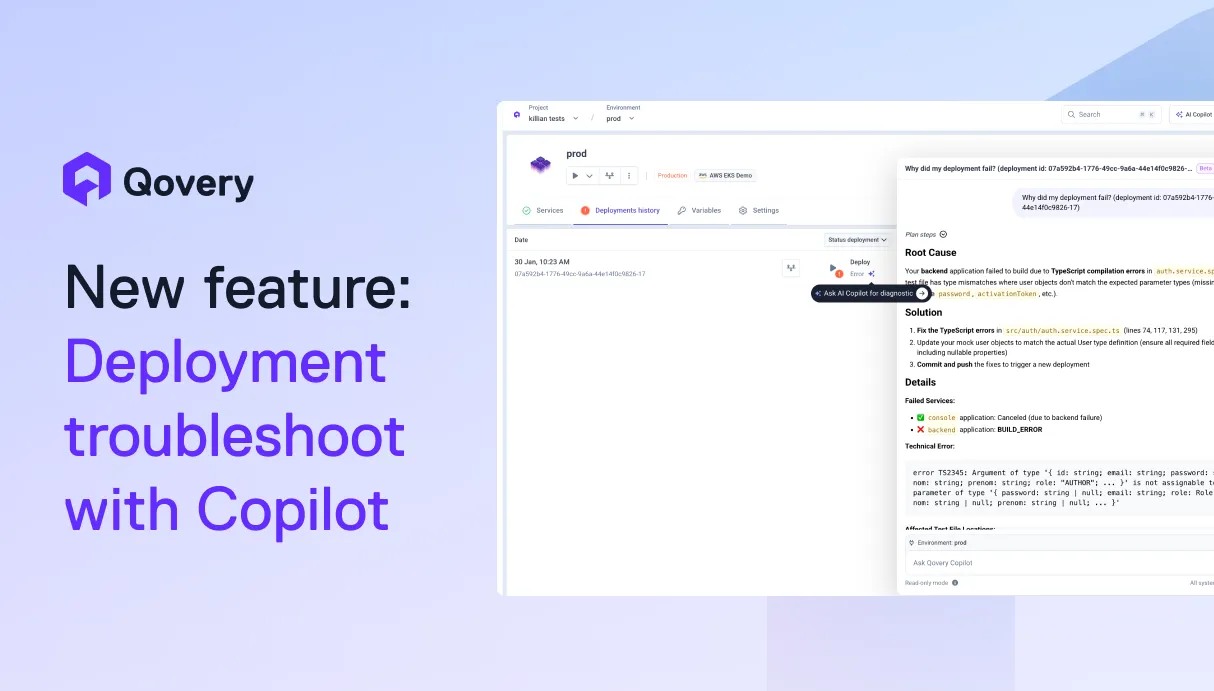
AI is helping developers write more code, faster than ever. But writing code is only half the story. What happens after? Building, deploying, debugging, scaling. That's where teams still lose hours.We're building Qovery for this era. Not just to deploy your code, but to make everything that comes after writing it just as fast.



By adopting GitOps and utilizing management platforms like Qovery, fintech teams can automatically generate DORA-compliant audit trails, transforming regulatory compliance from a manual, time-consuming chore into an automated, native byproduct of their infrastructure.
Kubernetes success is determined by Day 2 execution, not Day 1 deployment. While migration is a bounded project, maintenance is an infinite loop that often consumes 40% of senior engineering capacity. To protect margins and velocity, enterprises must transition from manual toil to agentic automation that handles scaling, security, and cost.
Day-0 is planning, Day-1 is deployment, and Day-2 is the infinite lifecycle of maintenance. While Day-0/1 are foundational, Day-2 is where enterprise operational debt accumulates. At fleet scale (1,000+ clusters), managing these differences manually is impossible, requiring agentic automation to maintain stability and eliminate toil.



.webp)