


Heroku vs. Kubernetes: A comprehensive comparison


Key Points:
- The Scaling Paradox: Heroku is built for speed (MVPs and prototypes), but Kubernetes is built for business growth. Heroku's over-simplistic autoscaling (latency-only) often fails complex applications that require scaling based on custom metrics, such as message queue backlogs.
- Orchestration Depth: While Heroku handles "siloed" applications well, it struggles with modern microservice architectures where dozens of independent services must communicate, fail gracefully, and scale independently.
- The "Exit Strategy" Cost: Heroku’s opinionated architecture can lead to total vendor lock-in. Switching later often requires a complete code rewrite, whereas the open-source, vendor-agnostic nature of Kubernetes allows you to run the same stack on any cloud or on-prem.
Every startup begins with a love affair with Heroku. But for high-growth teams, that love often turns into an expensive, restrictive marriage. Is it time to move to Kubernetes?
The trade-off has always been clear: Heroku for speed, Kubernetes (K8s) for power.
But as the cloud ecosystem matures, that line is thinning. Teams are realizing that while the "Platform as a Service" (PaaS) model of Heroku is convenient for a hackathon, the "Heroku Tax," consisting of the cost of scaling and the lack of deep orchestration, is a price they can no longer afford to pay.
Heroku vs. Kubernetes: A Comparison
The "Heroku Tax" & The CFO Problem
In the early days, your cloud bill is a rounding error. But as you hit scale, Heroku becomes a premium you can't justify.
- The 2x Premium: Heroku is frequently at least double the price of raw Amazon resources.
- The "New Employee" Math: For a mid-sized company spending $100k+ on Heroku, switching to Kubernetes could save enough budget to hire an entire new engineer.
Complexity: Beyond Latency Scaling
The biggest technical limitation of Heroku is its "opinionated" autoscaling. Most modern apps need to scale based on more than just web latency.
- The Queue Problem: If your application needs to scale up based on a message queue backlog (for example, processing thousands of videos), Heroku can't handle it.
- The Kubernetes Advantage: K8s allows for "Horizontal Pod Autoscaling" based on almost any metric, including CPU, memory, or custom external events.
Related Reading: Not ready for full Kubernetes? Read our breakdown of the top Heroku Alternatives for growing teams.
Orchestration: The Netflix Factor
If your app is a single binary, Heroku is perfect. But if you’re building a complex distributed system (where search, recommendations, and streaming are all independent services), you need a real orchestrator.
- Inter-service Communication: Kubernetes shines in managing how dozens of sub-apps interact, fail gracefully, and produce a single user experience.
- Future-Proofing: Writing your app for Kubernetes means it is vendor-agnostic from Day 1. You can move from AWS to GCP, or even back to on-prem, without a code rewrite.

The Migration: Mapping Concepts
If you’re moving from Heroku to Kubernetes, the mental shift looks like this:
- Dynos (Pods): Your running processes move to K8s Pods.
- Add-ons (Managed Services): Instead of Heroku Postgres, you use AWS RDS or GCP Cloud SQL.
- Buildpacks (Dockerfiles): You gain the freedom to define your environment exactly how you want it.
Conclusion: When to Stay and When to Go
If you're a small team building an MVP or a prototype for a hackathon, stay on Heroku. The speed of getting code out the door is your most valuable asset.
But if you anticipate complex orchestration needs, custom autoscaling, or a cloud bill that's making your CFO nervous, the move to Kubernetes is an investment in your company’s future. Don’t let the fear of complexity stop you (you don't hate Kubernetes; you hate the 'Toil' of managing it).
If you aren't ready for the full K8s jump, check out our guide to the best Kubernetes alternatives for a middle-ground solution
Why Qovery is the "Golden Path"
Instead of forcing you to choose between the simplicity of Heroku and the power of Kubernetes, Qovery gives you both. By adding a developer-friendly abstraction layer over your own AWS or GCP account, Qovery automates the "Day 2" operations that make Kubernetes so intimidating.
You get the "Git Push" velocity you love from Heroku, but with the cost-efficiency and unlimited scaling of a production-grade Kubernetes cluster. Before you commit to a manual migration, see how Qovery simplifies the jump from Heroku to Kubernetes.


.svg)
.svg)
.svg)

Suggested articles


At enterprise scale, managing provider-specific Kubernetes YAML across multiple clouds creates crippling configuration drift and operational toil. By adopting an agentic Kubernetes management platform, infrastructure teams abstract cloud-specific configurations (like ingress controllers and storage classes) into a single, declarative intent that automatically reconciles across 1,000+ clusters.
To stop GPU costs from destroying SaaS margins, teams must transition from static to consumption-based infrastructure by utilizing Karpenter for dynamic provisioning, maximizing hardware density with NVIDIA MIG, and leveraging Qovery to tie scaling directly to business metrics.
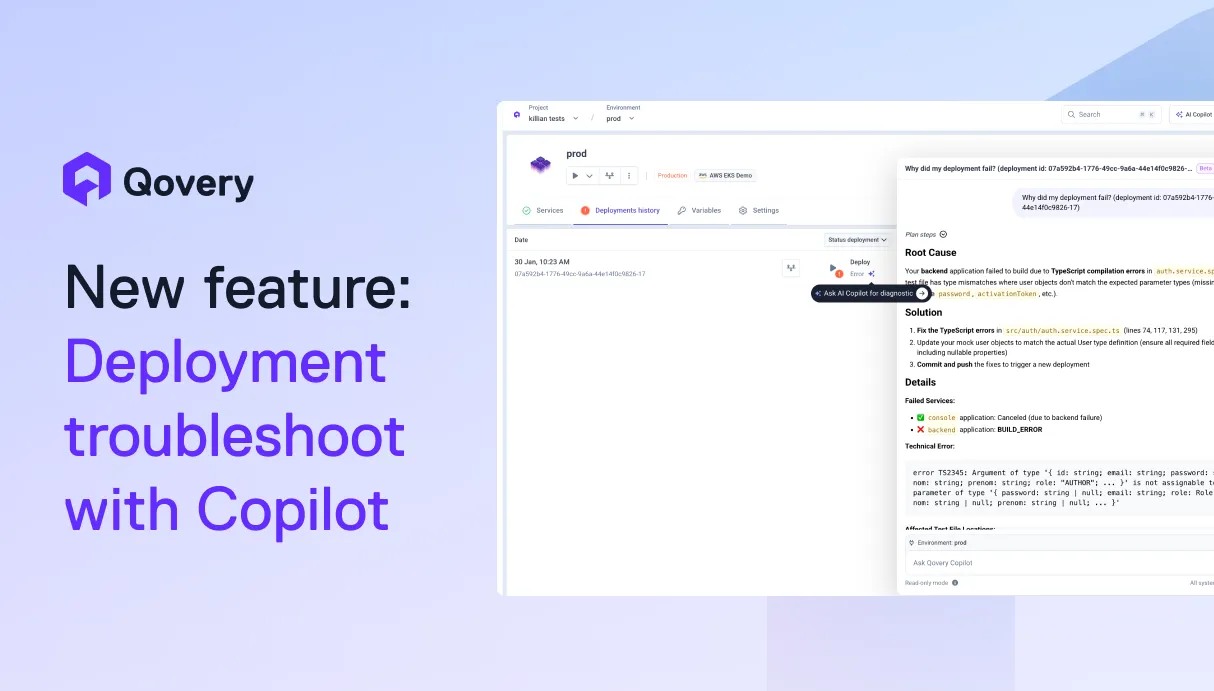
AI is helping developers write more code, faster than ever. But writing code is only half the story. What happens after? Building, deploying, debugging, scaling. That's where teams still lose hours.We're building Qovery for this era. Not just to deploy your code, but to make everything that comes after writing it just as fast.



By adopting GitOps and utilizing management platforms like Qovery, fintech teams can automatically generate DORA-compliant audit trails, transforming regulatory compliance from a manual, time-consuming chore into an automated, native byproduct of their infrastructure.
Kubernetes success is determined by Day 2 execution, not Day 1 deployment. While migration is a bounded project, maintenance is an infinite loop that often consumes 40% of senior engineering capacity. To protect margins and velocity, enterprises must transition from manual toil to agentic automation that handles scaling, security, and cost.
Day-0 is planning, Day-1 is deployment, and Day-2 is the infinite lifecycle of maintenance. While Day-0/1 are foundational, Day-2 is where enterprise operational debt accumulates. At fleet scale (1,000+ clusters), managing these differences manually is impossible, requiring agentic automation to maintain stability and eliminate toil.



.webp)