


How Qovery uses Qovery to speed up its AI project


At Qovery we use our own products every day. We believe it is the fastest way to build empathy for our users and push innovation further. Whether it’s a frontend engineer using Preview Environments to test a pull request in isolation or our backend team refining our API, Qovery is the heartbeat of our development lifecycle.
But today is another story, we’re taking you behind the scenes to show how we use Qovery to speed up our new AI initiative.
The Challenge: Speed vs. Complexity
We’ve been busy developing our AI DevOps Copilot, an AI assistant designed to redefine how developers interact with infrastructure. Our goal was simple: help developers and DevOps teams resolve daily operational headaches so they can stay focused on strategic, high-value work.
To build this, we needed the right talent. We found an incredible AI expert to lead the initiative. He is a master of Large Language Models (LLMs) and data science, but like many specialized developers, his expertise isn't in infrastructure, Kubernetes clusters, DNS configuration, or deployment management.
In a typical setup, this engineer would have spent weeks waiting for a Senior Reliability Engineer (SRE) to:
- Set up CI/CD pipelines.
- Configure Kubernetes and Helm charts.
- Manage DNS and SSL certificates.
- Provision databases and monitoring.
Weeks of back-and-forth, copy/pasting of YAML configuration to put in place even before his code can reach its target, clients.
How He Plugged the AI Stack into Qovery
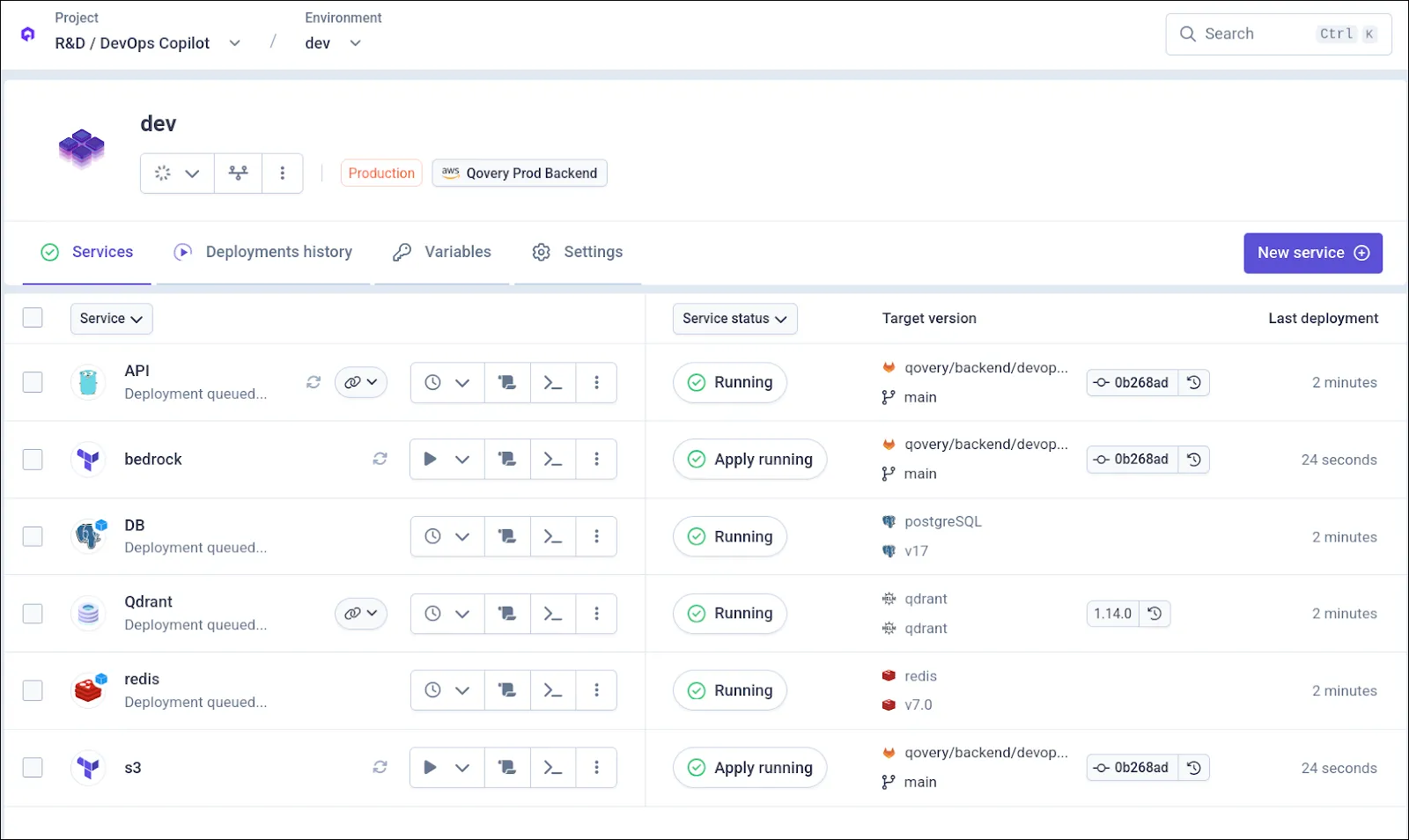
For our AI lead, the challenge wasn't just writing the code; it was ensuring that code could talk to the right data and scale on demand. Here is exactly how he "plugged" the AI stack into Qovery:
- Connecting the Brain (LLM & QDrant):
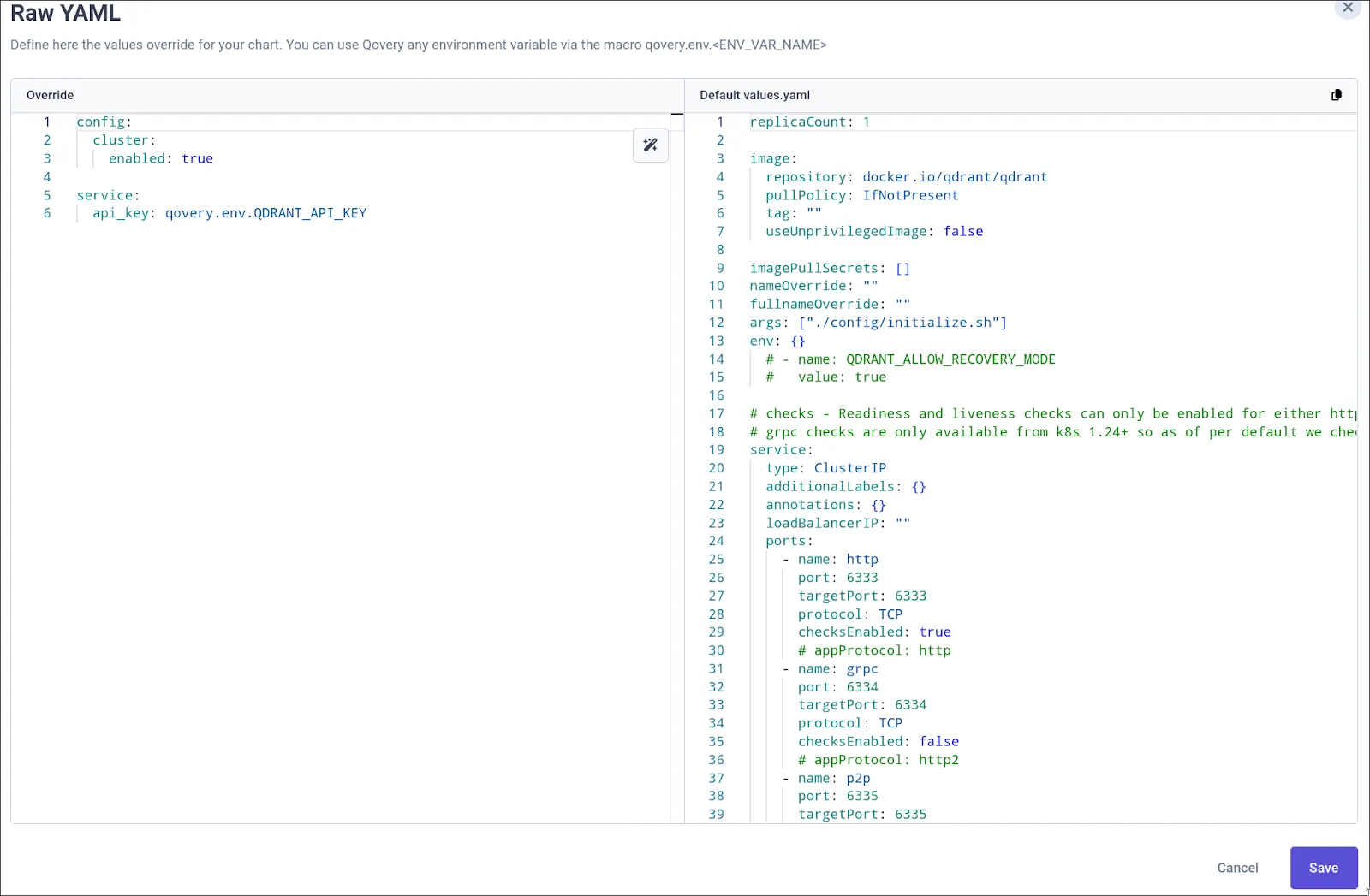
The core part of the application containing the agent and MCP server is built using our automatic docker image builder pipeline and request on-demand GPU nodes during deployment. To function, it needs to connect to databases; while Qovery provides ready-to-deploy SQL databases, we initially lacked a solution for vector databases like Qdrant to store model embeddings. To solve this, we leveraged Qovery’s Helm deployment system to deploy the official chart of QDrant, without the need for our AI lead to touch any CI/CD pipeline.
- Automated scaling with KEDA
Since some operations of the agent can require a lot of memory, we enabled our beta autoscaling based on KEDA. This ensures we have the correct number of replicas to handle the load and set a readiness probe to stop serving traffic once a threshold is reached.
- Managing the "State" with Terraform
As the product grows, so do its dependencies; our AI lead soon needed to store data into object storage. Instead of opening a ticket to our SRE to handle the creation of the S3 bucket, he used Qovery’s new Terraform integration to manage the lifecycle of S3 bucket directly within him environment, making him completely autonomous.
Empowering the Individual
With Qovery, our AI lead pushed his application to production in a single day. He didn't just "deploy code"; he deployed a production-grade system with all the "safeties" an SRE requires, handled automatically by the platform:
- Automatic Rollbacks: Instant recovery if a new model version fails liveness probes.
- Deterministic Builds: Using Docker to ensure the AI environment is identical from local to prod.
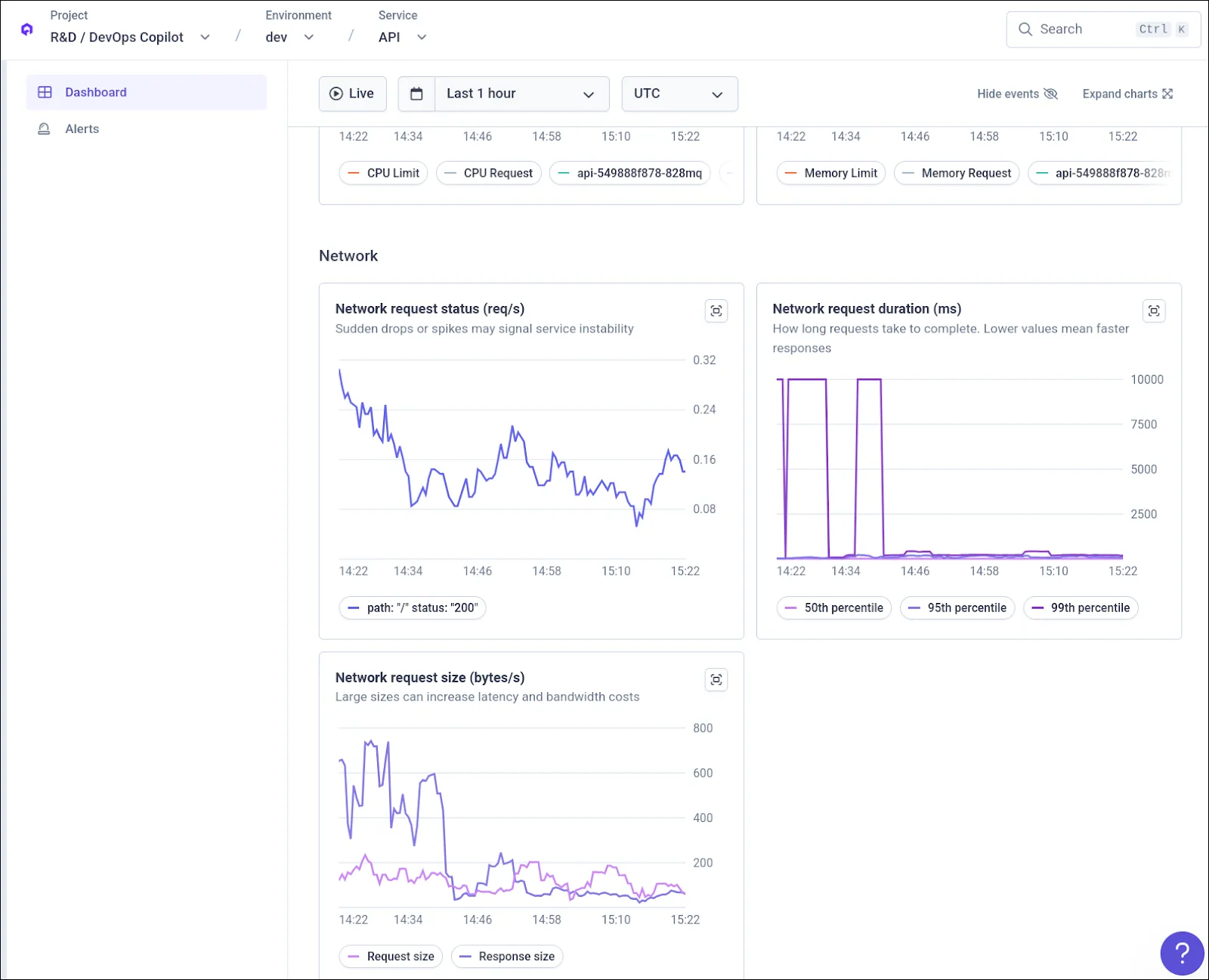
- Full Observability: Real-time monitoring to observe the live state of the agent's performance.
Conclusion: Infrastructure as Leverage
We are really proud of our new AI DevOps Copilot initiative, It proves what we’ve always believed: Infrastructure should be leverage and AI is a big advantage for the future
Qovery has become the platform we envisioned: a place where developers are empowered to move at the speed of their ideas, and DevOps teams know the guardrails are baked into the system.
Check out our AI Copilot or try Qovery yourself!


.svg)
.svg)
.svg)

Suggested articles


At enterprise scale, managing provider-specific Kubernetes YAML across multiple clouds creates crippling configuration drift and operational toil. By adopting an agentic Kubernetes management platform, infrastructure teams abstract cloud-specific configurations (like ingress controllers and storage classes) into a single, declarative intent that automatically reconciles across 1,000+ clusters.

To stop GPU costs from destroying SaaS margins, teams must transition from static to consumption-based infrastructure by utilizing Karpenter for dynamic provisioning, maximizing hardware density with NVIDIA MIG, and leveraging Qovery to tie scaling directly to business metrics.
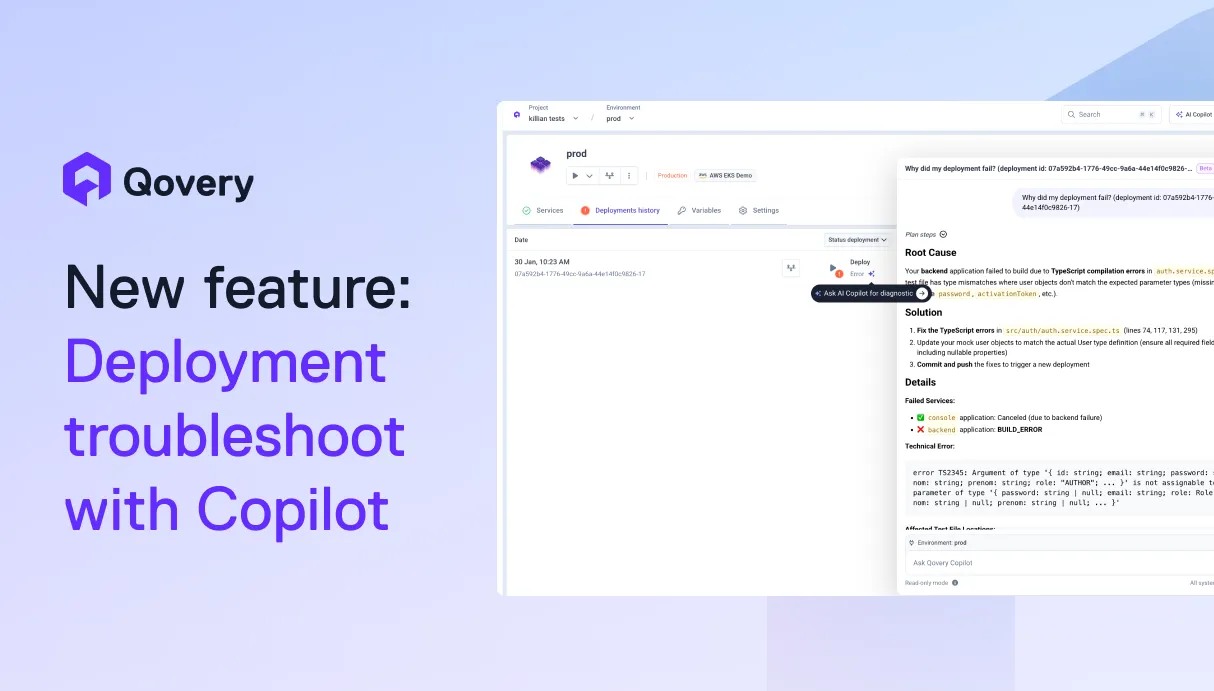
AI is helping developers write more code, faster than ever. But writing code is only half the story. What happens after? Building, deploying, debugging, scaling. That's where teams still lose hours.We're building Qovery for this era. Not just to deploy your code, but to make everything that comes after writing it just as fast.


By adopting GitOps and utilizing management platforms like Qovery, fintech teams can automatically generate DORA-compliant audit trails, transforming regulatory compliance from a manual, time-consuming chore into an automated, native byproduct of their infrastructure.
Kubernetes success is determined by Day 2 execution, not Day 1 deployment. While migration is a bounded project, maintenance is an infinite loop that often consumes 40% of senior engineering capacity. To protect margins and velocity, enterprises must transition from manual toil to agentic automation that handles scaling, security, and cost.
Day-0 is planning, Day-1 is deployment, and Day-2 is the infinite lifecycle of maintenance. While Day-0/1 are foundational, Day-2 is where enterprise operational debt accumulates. At fleet scale (1,000+ clusters), managing these differences manually is impossible, requiring agentic automation to maintain stability and eliminate toil.



.webp)