


Top 5 Kubernetes automation tools for streamlined management and efficiency


Key Points:
- Kubernetes automation is critical for scaling, a need amplified by 2026 trends like AI-powered DevOps, advanced DevSecOps, and Platform Engineering.
- While many DevOps engineers start by looking for isolated automation tools, leading teams are adopting unified Kubernetes management platforms to simplify cluster provisioning, automate workflows, and enhance reliability all in one place.
- This article explores five leading Kubernetes automation solutions, covering everything from GitOps CI/CD and policy enforcement to the comprehensive automation provided by modern management platforms.
Kubernetes has transformed application deployment and scaling, but managing it at an enterprise scale demands robust automation. In 2026, driven by the rise of Internal Developer Platforms (IDPs) and advanced DevSecOps, automating your Kubernetes environment is more vital than ever.
DevOps engineers and cloud platform teams are actively seeking tools to eliminate manual configurations and speed up deployments.
This article explores the leading Kubernetes automation tools essential for optimizing your operations, and explains why the ultimate automation solution might actually be a management platform.
Kubernetes Deployment Automation: Streamlining Modern Application Management
Deployment automation in Kubernetes refers to the process of scripting and automating the setup, scaling, and management of applications within your clusters. This automation reduces human error, speeds up release cycles, and ensures consistent configurations across multiple environments.
Core Components and Native Automation in Kubernetes
- Pods: The smallest deployable unit, representing a single application instance, potentially containing multiple containers.
- ReplicaSets: Ensure a specified number of identical pod replicas are continuously running, crucial for maintaining application availability by replacing failed or terminated pods.
- Deployments: A higher-level construct that manages ReplicaSets, enabling declarative updates, scaling, rolling updates, and automated rollbacks for applications.
Top 5 Kubernetes Automation Tools
1. Qovery - The Automated Kubernetes Management Platform
While you might be looking for a single automation tool, Qovery acts as a fully-fledged, enterprise-grade Kubernetes management platform that handles automation natively. It wraps the complexity of cloud-native infrastructure into a seamless, automated experience.
- What it does: Automates cluster provisioning (AWS, GCP, Azure), handles zero-downtime deployments, auto-generates preview environments, and provides cost-aware auto-scaling, all from a single control plane.
- Why you'd want it: To get an out-of-the-box Internal Developer Platform (IDP) with built-in automation. It allows platform teams to maintain strict governance over clusters while giving developers a frictionless, automated self-service portal to deploy apps.
- Weaknesses to consider: Qovery is highly opinionated to maximize speed and security. If your team strictly requires deep, manual, low-level tweaking of every underlying open-source component, it may feel too restrictive. Additionally, it is a commercial SaaS platform designed for public cloud environments, meaning it is not suited for 100% bare-metal, on-premises air-gapped setups.

2. Argo CD - The GitOps Automation Conductor
Argo CD is a highly specialized automation tool for Git-driven continuous delivery within your clusters.
- What it does: Automates GitOps deployments, provides drift detection, and visualizes application states.
- Why you'd want it: To completely automate the synchronization between your Git repository and your Kubernetes cluster, eliminating manual
kubectl applycommands. - Weaknesses to consider: Argo CD is strictly a Continuous Delivery (CD) tool. It doesn't help you provision the cluster itself, manage infrastructure, or provide developer self-service. It also lacks built-in secret management, requiring you to integrate and maintain third-party plugins (like HashiCorp Vault or SOPS).
3. Rancher - The Multi-Cluster Command Center
If your primary pain point is orchestrating raw clusters across hybrid environments, Rancher helps automate multi-cluster operations.
- What it does: Automates global policy enforcement and centralizes authentication across multiple clouds and on-prem environments.
- Why you'd want it: To bring sprawling, disparate Kubernetes clusters under a single pane of glass for IT operations.
- Weaknesses to consider: Rancher carries a heavy operational overhead; you have to maintain the management cluster itself. Furthermore, it focuses almost entirely on operator-level orchestration, leaving the actual developer experience and application deployment pipeline abstraction largely unsolved.
Read more: Qovery vs. Rancher Comparison
4. Open Policy Agent (OPA) / Gatekeeper: The Guardian of Your Rules
Security automation is a core pillar of a healthy cluster. OPA lets you automate the enforcement of strict governance policies.
- What it does: Automates fine-grained policy enforcement (naming, resource limits, security) by integrating with Kubernetes admission controllers.
- Why you'd want it: To automatically block developers from deploying insecure or non-compliant configurations to the cluster.
- Weaknesses to consider: OPA is notorious for its incredibly steep learning curve. Policies must be written in Rego, a complex, domain-specific language that is notoriously difficult to learn, write, and debug. It is also purely a policy engine, not a holistic security platform.
5. Prometheus & Grafana: Automated Observability
You can't automate what you can't measure. Prometheus and Grafana are the industry-standard tools for automating cluster observability and alerting.
- What it does: Automates real-time metrics collection and triggers powerful alerts based on cluster health.
- Why you'd want it: To automatically monitor resource allocation and get pinged before a bottleneck brings down your application.
- Weaknesses to consider: Managing a highly available Prometheus/Grafana stack across multiple clusters is a full-time job. It is highly prone to cardinality issues (exploding metric data) that cause massive spikes in cloud storage costs. Without meticulous tuning, teams often suffer from severe alert fatigue.
Why Choose Qovery Over a DIY Toolchain?
Rather than acting as just another isolated automation script, Qovery serves as a unified Kubernetes management platform. It delivers the automated capabilities of the "stack of 5" while neutralizing their individual weaknesses.
Building an automation pipeline from best-of-breed open-source tools leads to:
- Increased Operational Burden: Maintaining the automation scripts, handling upgrades, and fixing broken integrations becomes a full-time job.
- Slower Developer Velocity: Fragmented automation often creates bottlenecks where developers still have to wait on Ops tickets.
- Higher Total Cost of Ownership: The cost of dedicated SREs just to maintain the automation stack (plus the hidden costs of storage and compute for the tools themselves) can easily outpace the savings of using open-source software.
Qovery cuts through this complexity. By providing a unified Kubernetes management platform, it handles the heavy lifting of automation for you, reduces your operational overhead, and allows your platform teams to focus on strategy.
"Qovery gave us the power of Kubernetes without the complexity. Our team can now deploy in three clicks, even during a live client general assembly meeting. We’ve reduced downtime, boosted our agility, and no longer worry about managing infrastructure."- Florent Blaison, Co-founder & CTO at Syment
Conclusion: Simplify Your Kubernetes Journey with Qovery
While stringing together specialized open-source automation tools offers high customization, it inevitably creates a massive operational burden.
Qovery provides a compelling alternative: an enterprise-grade Kubernetes management platform that natively automates your clusters, secures your environments, and empowers your developers—all from a single control plane.
To go deeper, 📥 Download the Kubernetes Day 2 Operations & Scaling Playbook to master platform engineering best practices.


.svg)
.svg)
.svg)

Suggested articles


At enterprise scale, managing provider-specific Kubernetes YAML across multiple clouds creates crippling configuration drift and operational toil. By adopting an agentic Kubernetes management platform, infrastructure teams abstract cloud-specific configurations (like ingress controllers and storage classes) into a single, declarative intent that automatically reconciles across 1,000+ clusters.
To stop GPU costs from destroying SaaS margins, teams must transition from static to consumption-based infrastructure by utilizing Karpenter for dynamic provisioning, maximizing hardware density with NVIDIA MIG, and leveraging Qovery to tie scaling directly to business metrics.
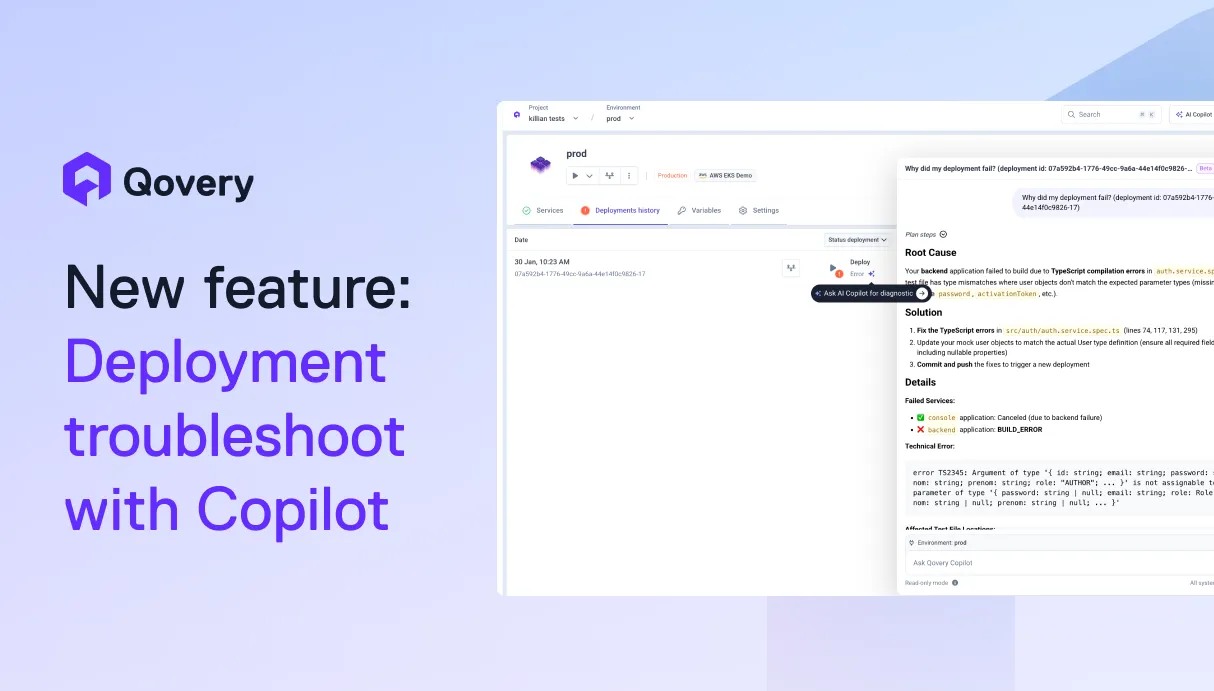
AI is helping developers write more code, faster than ever. But writing code is only half the story. What happens after? Building, deploying, debugging, scaling. That's where teams still lose hours.We're building Qovery for this era. Not just to deploy your code, but to make everything that comes after writing it just as fast.



By adopting GitOps and utilizing management platforms like Qovery, fintech teams can automatically generate DORA-compliant audit trails, transforming regulatory compliance from a manual, time-consuming chore into an automated, native byproduct of their infrastructure.
Kubernetes success is determined by Day 2 execution, not Day 1 deployment. While migration is a bounded project, maintenance is an infinite loop that often consumes 40% of senior engineering capacity. To protect margins and velocity, enterprises must transition from manual toil to agentic automation that handles scaling, security, and cost.
Day-0 is planning, Day-1 is deployment, and Day-2 is the infinite lifecycle of maintenance. While Day-0/1 are foundational, Day-2 is where enterprise operational debt accumulates. At fleet scale (1,000+ clusters), managing these differences manually is impossible, requiring agentic automation to maintain stability and eliminate toil.



.webp)