


Top 10 Platform9 alternatives: best managed Kubernetes solutions for scale


Key points:
Platform9 users typically look for alternatives for one of three reasons:
- To Focus on Applications: Qovery. Stop managing the "Private Cloud" layer and move to a self-service IDP on standard cloud infrastructure.
- To Manage Hybrid Fleets: Rancher. The open-source standard for managing On-Prem + Cloud clusters without the SaaS dependency.
- To Simplify Edge/Metal: Spectro Cloud. Deep control over bare-metal profiles and edge locations.
Platform9 made a name for itself by offering "SaaS Managed Kubernetes" for bare metal. It promised to be the "Virtual Ops Team" that remotely patched your on-premise control plane, allowing you to run a private cloud with the ease of AWS.
But for many organizations, Platform9 solves the wrong problem.
It focuses entirely on Infrastructure Operations (keeping the nodes running) rather than Developer Velocity (shipping code). You still end up with a raw Kubernetes cluster that developers find hard to use. Furthermore, the reliance on a SaaS control plane for on-premise hardware can be a blocker for strictly air-gapped environments.
We analyzed the top 10 alternatives, categorizing them into Developer Platforms (App focus) and Infrastructure Managers (Ops focus).
Quick View: Top Platform9 Alternatives
1. Qovery – The "Developer-First" Alternative
Best For: Teams who realize that managing "Private Cloud" is a distraction from shipping products.
The Strategy: Platform9 manages your Nodes. Qovery is a Kubernetes management platform thatmanages your Apps. If your goal is to give developers a self-service experience (like Heroku), Platform9 only gets you halfway there. Qovery sits on top of your cloud (AWS/EKS) and provides a complete Internal Developer Platform, automating the deployment pipelines, preview environments, and security patching that Platform9 leaves to you.
Pros:
- Developer Experience: Turns Kubernetes into a fully automated PaaS. Developers never touch
kubectl. - Zero Maintenance: It is a managed control plane; you don't need to patch the management server.
- FinOps: Built-in cost optimization that tracks spend per application/environment.
Cons:
- Not for Bare Metal OS: Qovery does not provision the Linux OS on physical servers like Platform9 does. You need a cloud provider or a managed cluster API.
- Connectivity: Requires a connection to the control plane.

2. Rancher (SUSE) – The Self-Hosted Standard
Best For: Ops teams who want to manage on-prem clusters without a SaaS dependency.
The Strategy: Platform9 requires a connection to their SaaS control plane. Rancher can be installed completely Air-Gapped inside your data center. It is the industry standard for managing the lifecycle of Kubernetes clusters (RKE, K3s) across diverse infrastructure.
Pros:
- Air-Gap Ready: Can run completely offline (Platform9 cannot).
- Cost: Open-source foundation allows for free adoption or paid support.
Cons:
- Maintenance: unlike Platform9, you are responsible for upgrading the Rancher management server. It is not "SaaS Managed."
Read more: Qovery vs. Rancher
3. Spectro Cloud (Palette) – The "Metal" Specialist
Best For: Managing full-stack profiles (OS + K8s) at the Edge.
The Strategy: If you liked Platform9 for its bare-metal capabilities, Spectro Cloud is the modern upgrade. It manages the entire stack including the Operating System using declarative profiles. It is excellent for preventing "drift" across 1,000 physical servers.
Pros:
- Full Stack: Controls the Linux OS layer, preventing configuration drift.
- Edge: Built specifically for low-connectivity environments where Platform9 might struggle.
Cons:
- Complexity: It is a heavy tool built for Operators, not Developers.
4. Red Hat OpenShift – The Enterprise OS
Best For: Highly regulated industries (Banking/Gov) requiring FIPS compliance.
The Strategy: OpenShift is the heavy-duty alternative. Like Platform9, it provides a "Batteries Included" platform. However, it is an entire Operating System (CoreOS) ecosystem, whereas Platform9 is more of a management overlay.
Pros:
- Security: Unmatched compliance certifications (FIPS, FedRAMP).
- Support: Backed by Red Hat / IBM.
Cons:
- Cost: Expensive per-core licensing.
- Lock-in: You are effectively married to the Red Hat ecosystem.
5. Nutanix (Karbon) – The HCI Appliance
Best For: Enterprises who want a "Turnkey" Private Cloud.
The Strategy: Platform9 tries to turn your existing messy hardware into a cloud. Nutanix sells you the hardware and software as a unified block (HCI). If you are buying new hardware, Nutanix is often smoother than trying to retrofit Platform9 onto old servers.
Pros:
- Simplicity: One vendor for Hardware, Storage, and Kubernetes.
- Stability: Extremely resilient storage layer.
Cons:
- Hardware Lock: You are buying into the Nutanix hardware ecosystem.
6. Mirantis – The Legacy Migrator
Best For: Organizations with legacy OpenStack or Docker Swarm workloads.
The Strategy: Platform9 started as "Managed OpenStack." Mirantis is the other major player in that space. If you have legacy telco workloads running on OpenStack, Mirantis is the direct competitor.
Pros:
- OpenStack: Deep expertise in telco-grade OpenStack operations.
- Swarm: Supports legacy Docker Swarm.
Cons:
- Dated: The ecosystem feels less modern than Cloud-Native tools like Qovery or Spectro.
7. EKS Anywhere / Google Anthos
Best For: Teams standardizing on a single Public Cloud provider.
The Strategy: AWS and Google now offer "On-Premise" versions of their cloud. EKS Anywhere allows you to run the EKS distro on your own hardware, managed by the AWS console.
Pros:
- Consistency: Use the same console for Cloud and On-Prem.
- Cost: Often cheaper than a specialized vendor like Platform9.
Cons:
- Complexity: Setting up EKS Anywhere on bare metal is non-trivial compared to Platform9's "Managed" promise.
8. Portainer – The Visual Manager
Best For: Smaller on-prem clusters or Homelabs.
The Strategy: Platform9 is overkill for a 3-node cluster. Portainer provides a lightweight UI to manage Docker and K8s environments locally.
Pros:
- Simplicity: Installs in seconds; almost zero learning curve.
- Price: Free/Cheap for small scale.
Cons:
- Governance: Lacks the multi-cluster fleet management features of Platform9.
9. Rafay – The "Governance" Engine
Best For: Platform teams enforcing strict standardization across shared services.
The Strategy: Like Platform9, Rafay uses a SaaS control plane. However, Rafay focuses heavily on Policy (OPA) and Governance rather than just "keeping the lights on."
Pros:
- Governance: Deep blueprinting features for large enterprises.
- Multi-Tenancy: Excellent isolation for shared clusters.
Cons:
- Overkill: Too complex for mid-sized organizations just wanting to ship code.
10. VMware Tanzu – The vSphere Integration
Best For: Teams who are not ready to leave VMware.
The Strategy: Platform9 is often positioned as a replacement for VMware. Tanzu is the extension of VMware. It runs Kubernetes inside your existing vSphere VMs, allowing Ops teams to use vCenter.
Pros:
- Familiarity: Ops teams use vCenter to manage K8s.
- Stability: Mature hypervisor integration.
Cons:
- Broadcom Risk: Rising costs make this a "Legacy" choice rather than a forward-looking one.
Conclusion: Which Platform9 Alternative is Right?
- For Bare Metal Ops: Use Spectro Cloud or Rancher.
- For Developer Velocity: Use Qovery - Kubernetes Management Platform.


.svg)
.svg)
.svg)

Suggested articles


At enterprise scale, managing provider-specific Kubernetes YAML across multiple clouds creates crippling configuration drift and operational toil. By adopting an agentic Kubernetes management platform, infrastructure teams abstract cloud-specific configurations (like ingress controllers and storage classes) into a single, declarative intent that automatically reconciles across 1,000+ clusters.
To stop GPU costs from destroying SaaS margins, teams must transition from static to consumption-based infrastructure by utilizing Karpenter for dynamic provisioning, maximizing hardware density with NVIDIA MIG, and leveraging Qovery to tie scaling directly to business metrics.
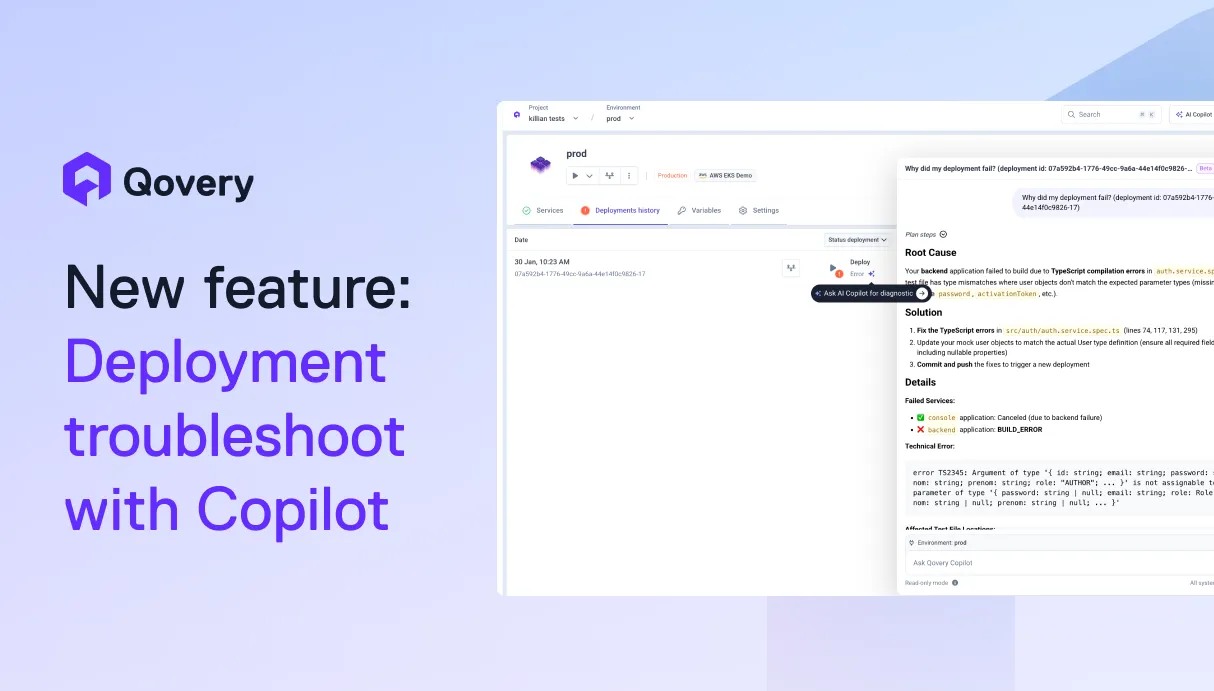
AI is helping developers write more code, faster than ever. But writing code is only half the story. What happens after? Building, deploying, debugging, scaling. That's where teams still lose hours.We're building Qovery for this era. Not just to deploy your code, but to make everything that comes after writing it just as fast.



By adopting GitOps and utilizing management platforms like Qovery, fintech teams can automatically generate DORA-compliant audit trails, transforming regulatory compliance from a manual, time-consuming chore into an automated, native byproduct of their infrastructure.
Kubernetes success is determined by Day 2 execution, not Day 1 deployment. While migration is a bounded project, maintenance is an infinite loop that often consumes 40% of senior engineering capacity. To protect margins and velocity, enterprises must transition from manual toil to agentic automation that handles scaling, security, and cost.
Day-0 is planning, Day-1 is deployment, and Day-2 is the infinite lifecycle of maintenance. While Day-0/1 are foundational, Day-2 is where enterprise operational debt accumulates. At fleet scale (1,000+ clusters), managing these differences manually is impossible, requiring agentic automation to maintain stability and eliminate toil.



.webp)